
A buyer looking for commercial property for sale in Rawalpindi should check location, commercial approval, ownership documents, development status, accessibility, surrounding businesses, rental demand, total purchase cost, expected ROI, and exit potential before making a decision.
Rawalpindi attracts commercial buyers through established business corridors, major roads, high-traffic areas, and growing mixed-use developments such as Sardar’s Mall. But not every commercial property offers the same investment potential.
This guide provides a practical checklist to help investors and business owners evaluate a commercial property before making a purchase.
Check the Location and Accessibility
Location remains one of the first things to evaluate when buying commercial property in Rawalpindi. A property may look attractive on paper, but poor access, limited visibility, or weak surrounding activity can make it difficult to attract customers and tenants.
Look at the property’s connection to major roads, residential areas, markets, offices, and other commercial zones. Consider how easily customers can reach the property by car and public transport.
Parking also matters. A shop on a busy road may have plenty of traffic, but if customers can’t conveniently stop there, the location may not perform as expected.
For investors, the surrounding area’s development is just as important as the property’s current position. New housing, offices, schools, hospitals, retail outlets, and road connections can influence future commercial demand.
Verify Commercial Approval and Ownership Documents
Before making a payment, verify that the property has the appropriate commercial approval and land-use status. For properties within a development project, also check the relevant approvals and permissions applicable to that project.
Ownership documents need the same attention. Depending on the property, these may include the sale deed, registry, mutation, land records, NOC, tax records, and other relevant documents.
If you’re buying a commercial unit in a newly developed project, review the developer’s documentation and the project’s approval status carefully.
A low price isn’t a bargain if the legal position isn’t clear. Have the documents reviewed by a qualified property lawyer or relevant professional before signing an agreement or transferring funds.
Assess Development and Construction Status
The property’s development stage can significantly affect both risk and return.
A ready commercial property allows you to inspect the actual building, access, surrounding activity, and rental market. You can also assess whether businesses are already operating nearby.
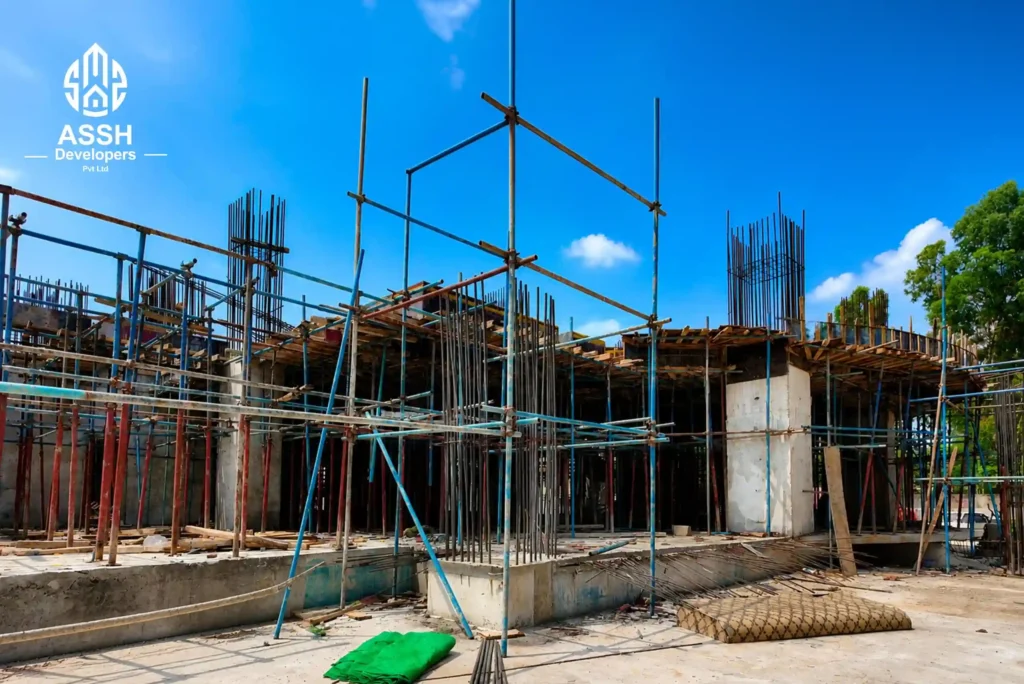
An under-construction commercial property may offer a lower entry price or flexible payment plan, but you’re taking on construction and possession risk. In this case, examine the developer’s delivery record, construction progress, development schedule, and payment terms.
Don’t look at the advertised completion date alone. Visit the project and assess the actual progress.
For a completed property, check construction quality, utilities, lifts, parking, common areas, maintenance arrangements, and building condition.
Evaluate Footfall and Surrounding Businesses
Commercial property depends heavily on economic activity around it. Visit the property at different times of day rather than relying on one quick visit. Observe vehicle movement, pedestrian activity, customer behaviour, occupied shops, vacant units, and the types of businesses operating nearby.
The surrounding tenant mix can also tell you a lot. For example, restaurants, banks, pharmacies, offices, salons, grocery stores, and other established businesses can create levels of customer traffic.
Ask a simple question: Who will actually come here, and why? If you can clearly identify the customer or tenant base, you’re in a much stronger position to evaluate the property.
Check Rental Demand and Income Potential
If your goal is rental income, don’t assume that a commercial property will automatically attract tenants.
Check the actual rental rates for comparable properties nearby. Speak with local property dealers, existing tenants, and owners where possible. Compare similar units based on size, floor, frontage, accessibility, parking, and condition.
Also consider vacancy periods. For instance, a property advertised at PKR 150,000 per month isn’t necessarily generating PKR 150,000 every month if it regularly remains vacant.
For a basic rental-yield calculation:
Rental Yield = (Annual Rental Income ÷ Total Property Cost) × 100
For example, if a commercial unit costs PKR 2 crore and generates PKR 120,000 per month in rent:
Annual rent = PKR 14.4 lakh
Gross rental yield = 7.2%
This is a gross calculation. Your actual return may be lower after considering maintenance, taxes, service charges, vacancies, and other expenses.
Calculate the Total Purchase Cost
The property’s advertised price isn’t always the final amount you’ll spend. Before committing, calculate the complete acquisition cost.
Depending on the transaction and property type, this may include:
- Property purchase price
- Booking or down payment
- Transfer and registration charges
- Applicable government taxes and duties
- Development or possession charges
- Parking charges
- Maintenance or service charges
- Utility connection charges
- Renovation or fit-out costs
- Brokerage and documentation costs
This gives you a more realistic investment figure.
For investors comparing multiple commercial properties for sale in Rawalpindi, calculating the complete cost rather than just the asking price can change which property offers the better deal.
Compare Commercial Property Prices in Rawalpindi
Compare prices of the property with similar commercial properties in the same area and, where relevant, nearby commercial zones. Price per square foot is useful, but it shouldn’t be the only metric.
Consider:
- Location
- Road frontage
- Floor
- Unit size
- Parking
- Possession status
- Construction quality
- Commercial approval
- Rental potential
- Development around the property
Two units with the same covered area can have very different values because one has better visibility, access, frontage, or tenant demand.
A cheaper property isn’t automatically the better investment.
Estimate ROI and Capital Appreciation
Commercial property investment usually has two potential return sources: rental income and capital appreciation.
Rental income can provide recurring cash flow, while capital appreciation depends on how the property’s market value changes over your holding period.
Before buying, consider the property’s current rental potential, expected future rent, purchase price, holding costs, development activity, demand, and likely resale value. For example, an investor might choose between a ready commercial unit generating rent today and an under-construction unit with a lower entry price but no immediate rental income.
The better option depends on your investment horizon, available capital, risk tolerance, and expected return.
Check Developer or Seller Credibility
If you’re buying from a commercial property developer, investigate the company before committing.
Look at its completed projects, construction progress, possession history, documentation, and reputation among previous buyers. Visit completed developments where possible, not only relying on marketing material.
For resale properties, verify the seller’s ownership and authority to sell. Also pay attention to how clearly the seller explains the payment schedule, charges, possession terms, approvals, and documentation. A professional transaction should leave you with clear answers, not unanswered questions.
Assess Resale and Exit Potential
You should know how you could exit the investment before you enter it.
Ask yourself: If I need to sell this property in three, five, or seven years, who is likely to buy it?
Properties with strong locations, clear documentation, active commercial demand, and reasonable pricing are generally easier to position for resale.
Unit size also matters. Extremely expensive units can have a smaller buyer pool, while well-priced units in active commercial areas may attract more investors and business owners.
Don’t focus only on how much a property could be worth in the future. Consider how easily you could actually find a buyer at that price.
Commercial Property Red Flags to Watch For
Some warning signs deserve immediate attention.
Be cautious if you encounter:
- Unclear ownership documents
- Missing or questionable commercial approvals
- Pressure to make an immediate payment
- Unrealistic rental-income promises
- Hidden development or maintenance charges
- Repeated possession delays
- Poor construction progress
- Limited access to the property
- High vacancy in the surrounding area
- Significant disputes or legal claims
- Prices that are far below comparable properties without a clear reason
A proper property assessment may take a little longer. That’s preferable to spending years dealing with a bad investment.
Ready to Invest in Commercial Property in Rawalpindi?
Choosing the right commercial property for sale in Rawalpindi comes down to more than finding an attractive price. You need to understand the location, legal status, development quality, rental demand, total investment, expected returns, and future resale potential.
If you’re considering a commercial property, speak with a local property expert who can help you evaluate the opportunity against your investment goals. Reach out to our team to explore suitable commercial property options in Rawalpindi and discuss the location, pricing, payment plan, development status, and potential returns before you invest.