Most of what buyers see of a construction project is a rendering, a brochure, and the occasional photo of a half-finished structure. What’s happening underneath that image — the actual coordination of trades, inspections, and phases that turns a hole in the ground into a mixed-use building — almost never makes it into marketing material.
It’s worth showing, because that coordination is a better indicator of a developer’s capability than any rendering. Here’s a look at how a multi-phase site like Sardar’s Mall actually runs.
The Phases of a Multi-Phase Build
A mixed-use project like Sardar’s Mall doesn’t move through construction as one single effort — it moves through overlapping phases, each with its own crews, inspections, and risks:
| Phase | What happens | What can go wrong if rushed |
| Substructure | Basement excavation, foundations, columns, shear walls, lift wells | Structural issues that are far more expensive to fix once the floors above are built |
| Structure | Floor-by-floor slab formwork and concrete pours, column and beam work rising through the tower | Delays here cascade directly into every phase above |
| Envelope | Exterior walls, glazing, roofing — making the building weathertight | Water ingress and finishing delays if sequencing with interior work isn’t planned |
| Fit-out | Electrical, plumbing, HVAC, interior finishes by zone (retail, offices, apartments) | Rework if fit-out starts before structural and envelope work in that zone is actually signed off |
The phases overlap by design — fit-out can begin on lower floors while structural work is still rising on upper ones — but that overlap only works if each phase is properly signed off before the next one builds on top of it.
What a Working Day on Site Actually Involves
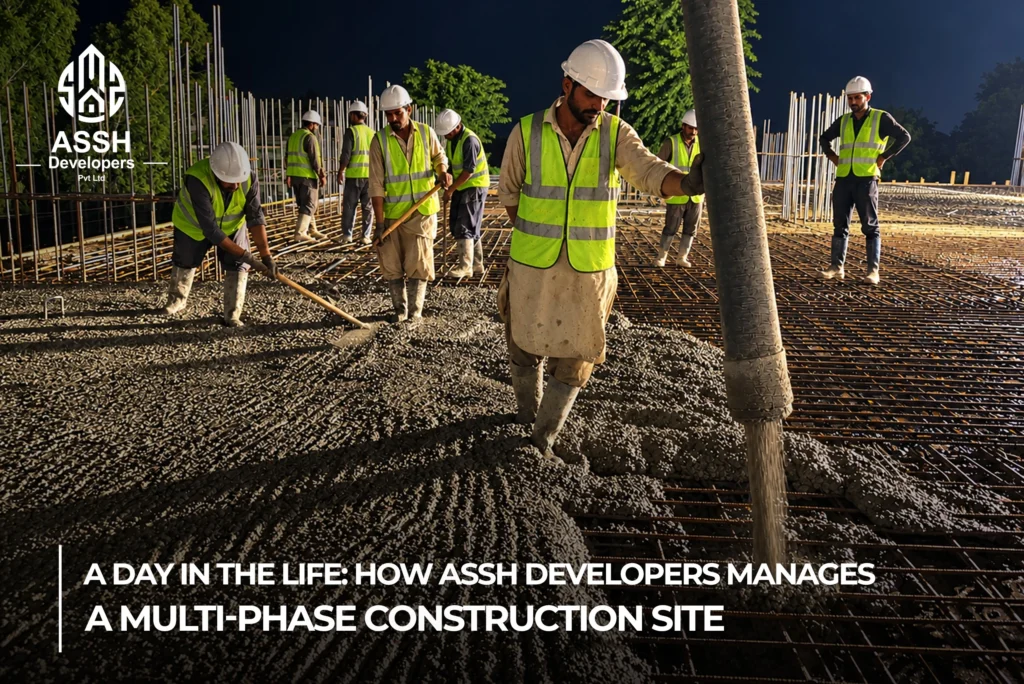
On any given day, a multi-phase site like this is running several of those phases at once, in different zones of the same building. A typical day’s work includes:
- Morning site walk: Checking overnight progress against the schedule, and flagging anything that needs attention before crews start — a concrete pour that needs curing time, a delivery that didn’t arrive.
- Trade coordination: Making sure crews working in the same area at the same time aren’t blocking each other — electricians can’t run conduit through a wall that’s still being formed, for instance.
- Inspection checkpoints: Structural elements, in particular, get signed off at defined stages — reinforcement checked before concrete is poured, concrete strength verified before formwork is removed — rather than reviewed only after the fact.
- Safety checks: Site access, protective equipment, and hazard areas get checked continuously, not just at the start of a shift.
- Progress reporting: What got done, what didn’t, and why, feeding back into the schedule for the next day and the next phase.
None of this is especially dramatic day to day. That’s the point — a well-run site looks unremarkable precisely because problems get caught at the checkpoint stage instead of becoming visible failures later.
Coordinating Trades Without One Blocking Another
The hardest part of a multi-phase site isn’t any single trade’s work — it’s the handoffs between them. A structural crew finishing a floor needs to clear out before electrical and plumbing rough-in can start in that same space. Fit-out finishers need the envelope sealed before they bring in finishes that water damage would ruin.
Getting this sequencing wrong is one of the most common ways projects fall behind schedule: not because any one trade worked slowly, but because the handoff between phases wasn’t planned tightly enough, and crews ended up waiting on each other or redoing work. A site that stays on schedule is usually one where that sequencing was mapped out in detail before the first phase even started, and adjusted continuously as real conditions — weather, material deliveries, inspection timing — shift the plan.
Why This Matters to Buyers and Investors
This kind of operational detail rarely shows up in a brochure, but it’s a more honest signal of a developer’s reliability than any marketing claim. A developer who can explain how they sequence phases and catch problems at inspection checkpoints is giving you something concrete to evaluate — unlike a vague promise that a project will be “delivered on time.”
If you’re comparing developers (see our guide to the questions worth asking before you invest), ask how they manage exactly this: the handoffs between phases, and what happens when a trade or inspection runs behind. The answer tells you more than the rendering ever will.
Frequently Asked Questions
What’s the difference between a construction phase and a milestone? A phase is a stage of work — substructure, structure, envelope, fit-out — that can run for weeks or months. A milestone is a specific checkpoint within or between phases, like “basement structure complete” or “building weathertight,” used to track whether the schedule is on track.
Why do construction projects get delayed even with good planning? Weather, material delivery delays, and inspection scheduling are the most common causes, and they’re rarely fully within a developer’s control. What separates well-managed sites is how quickly those disruptions get absorbed into a revised plan rather than allowed to cascade into every later phase.
How often are inspections actually carried out? Structural and safety inspections happen at defined checkpoints tied to the work itself — before a concrete pour, before formwork is removed, before a space is handed to the next trade — rather than on a fixed calendar schedule.
Can buyers or investors visit the site during construction? Many developers allow scheduled site visits for serious buyers, subject to site safety requirements. If this matters to you, ask directly — a developer’s willingness to arrange one is itself informative.
What’s the riskiest phase of a multi-phase build? Substructure and structural work carry the highest risk, since problems there are the most expensive to fix once later phases are built on top. That’s why inspection checkpoints are concentrated most heavily in these early phases.
Watch It in Progress
Sardar’s Mall is the live example of this process underway. Follow construction progress on the project site, or contact ASSH Developers if you’d like to discuss our site management and quality process directly.