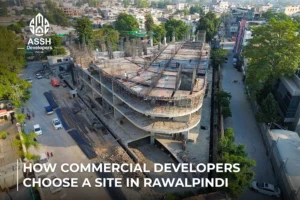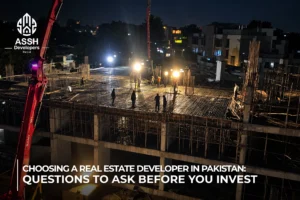
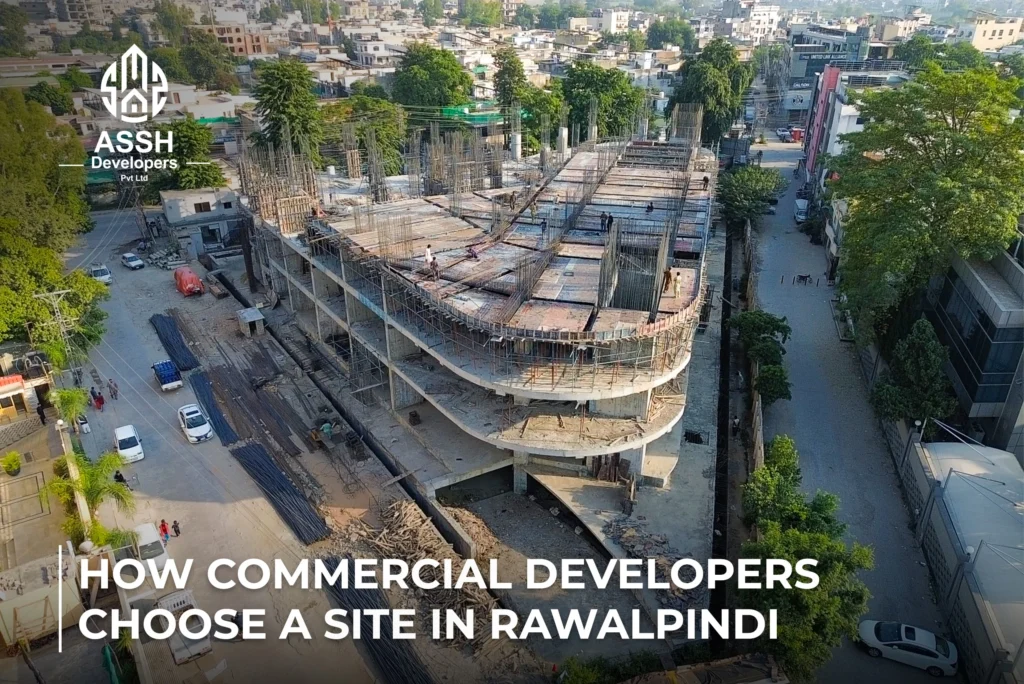
A commercial developer in Rawalpindi chooses a site by testing five things in a fixed order. These are legal land use, road access, allowable height, utilities and ground conditions, and visitor flow.
A plot that fails any one of these checks rarely becomes a sound commercial building. This guide explains each check so buyers, tenants, and landowners can judge a developer’s choice.
Check One: Legal Land Use
The first question is whether the plot may be used for commercial purposes at all. Rawalpindi Development Authority land-use rules decide which uses are allowed on residential, commercial, and mixed-use roads.
The authority has taken action against commercial buildings that went up without the required approvals or No Objection Certificates. A site with unclear land use can lead to a stopped project, so developers confirm it before design begins.
Who Approves What
A report on the fire safety audit explains that commercial building plans are approved by the Municipal Corporation. It adds that the Rawalpindi Development Authority is the body that regulates high-rise buildings in the district. Ask any developer which body approved each part of the project, and ask to see the letters.
Check Two: Road Access and Visibility
Commercial buildings depend on visitors, so the road in front of the plot matters a great deal. Developers study the width of the road, the number of entry points, and how easily cars can turn in.
Corner plots and plots near major junctions usually give a building more visibility and more ways in. They can also bring heavy traffic, so the design must handle queues at the gate.
Transit Nearby
Public transport brings visitors to a building without adding to the pressure on its parking. The Metrobus Red Line runs along Murree Road and stops at Chandni Chowk, so nearby plots gain passengers.
Check Three: Allowable Height
Height decides how much space a building can offer on a given plot. Under the authority’s rules, height depends on road width, plot size, and Civil Aviation Authority clearance where needed.
In 2019 the authority adopted building rules that allow ten-storey buildings in the city. Later amendments also allowed buildings of up to 100 feet on GT Road. A developer should show the approved height in writing before selling any unit.
Check Four: Utilities and Ground Conditions
A site needs water, sewerage, power, and a stable base for the foundation. Developers study the soil through a geotechnical investigation before they finalise the structural design.
Rawalpindi and Islamabad also sit close to an area of higher earthquake risk, so soil studies matter. A 2009 Zameen news report quoted an official saying both cities lie on the border of the red zone. Ask whether a soil report exists for the plot and which engineer signed it.
Check Five: The Flow of Visitors
Developers study who will use the building and how those people will arrive. They count nearby homes, offices, schools, and shops, and they watch how busy the area is at different hours.
A mixed-use building needs several groups of users, so the site should sit near homes as well as workplaces. Developers also check whether competing projects nearby will serve exactly the same group of people.
A Simple Site Checklist for Buyers
You do not need to be an engineer to ask a developer good questions about its site. Use this list with any developer, and keep every written answer for your own records.
- Which authority approved the land use, and where is the letter?
- What height did it approve, and does it match the marketing plan?
- How wide is the access road, and where do cars enter and exit?
- Is there a soil report, and who signed it?
- How far is the nearest public transport stop?
Applying the Checks to Sardar’s Mall
Sardar’s Mall sits at Plot 54-C, Iran Road, Block C, Satellite Town, on 8.51 kanals. Use the same five checks on that site during a visit, and ask ASSH Developers for the documents.
The developer states that the project has approval from the Rawalpindi Development Authority. Confirm that statement with the authority and read the construction updates for progress.
Frequently Asked Questions
How does a commercial developer choose a site in Rawalpindi?
A developer checks land use, road access, allowable height, utilities and ground conditions, and visitor flow. A plot must pass all five of these checks before any serious design work begins.
Who approves commercial buildings in Rawalpindi?
Reports say the Municipal Corporation approves commercial building plans and the Rawalpindi Development Authority regulates high-rise buildings. Ask the developer to show each approval in writing and confirm it with the authority.
Why does allowable height matter?
Height decides how much space a plot can hold, and it must match the approved plan. Rules depend on road width, plot size, and Civil Aviation Authority clearance where it applies.
Does the site affect earthquake safety?
Yes, because ground conditions influence the foundation design of every tall building in the city. Ask for the soil report and the seismic design details before you buy.
Final Word
A good site starts with legal land use and ends with real visitors. Ask for every document in writing and check each claim with the authority yourself.